Posts

Why put communities at the centre of Uganda’s oil and gas resource management?

By Joseph Mawejje, Research Analyst Natural resource management and governance often ignore the needs, fears and concerns of the local communities to both the government and the people’s detriment.  Too often the needs of local communities are overlooked when such great economic opportunities arise.  While local communities often expect great things from new natural resource discoveries, they also fear and anticipate marginalisation by the government and the incoming corporations, according to a study by the Economic Policy and Research Centre (EPRC) that examines how prepared Uganda is to accelerate growth and maintain intergenerational equity, the impact of the burgeoning Ugandan oil sector on the lives and concerns of the people most directly affected by this new industry. The last decade has seen resurgence in interest of the vast natural resources in Africa. Oil and gas resources have been at the forefront of natural resource exploration in many countries in A...
Is Liberalization the key to Increased Milk Production In Uganda?

By Musa Mayanja Lwanga Research Analyst Recent findings suggest that liberalisation of the Ugandan agricultural sector has created positive responses in the dairy sector.   A study by the Economic Policy Research Centre (EPRC) has found that policies that took effect in the 1990s have increased total milk production, enhanced the variety of available dairy products and actually created growth in the related livestock sector as well.   In addition, through their value chain analysis study, EPRC scholars Dr. Swaibu Mbowa, Mr. Isaac Shinyekwa and Mr. Musa Mayanja Lwanga noted that that the development of the value chain in the dairy sector has led to employment creation and income generation not only for dairy farming households, but also for farm input dealers, dairy equipment dealers, dairy ingredients dealers, raw milk traders, milk transporters, mini-dairies, large scale milk processors, and distributors. Total national milk production has grown from 460 million lit...

EPRC raises the level of oil discussions in Uganda

Image
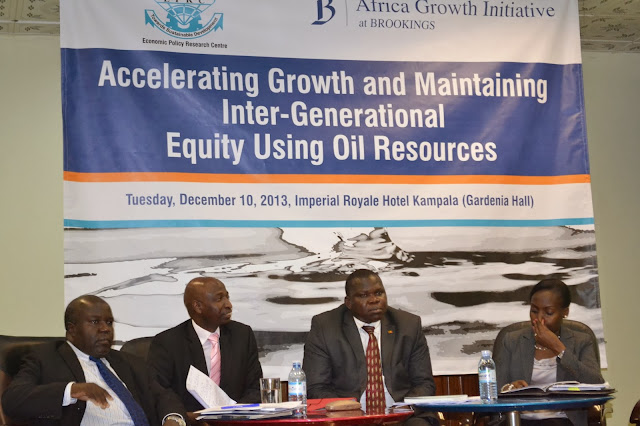
By Esther Nakkazi Ministry of Energy and Mineral Development officials have commended the Economic Policy Research Centre (EPRC) for the research on oil for intergenerational equity. They say EPRC researchers have raised the level of discussion in the oil and gas sector taking adequate stock of what has been done and giving a positive look at what will happen. The research is in a published paper entitled ‘Accelerating Growth and maintaining Intergenerational Equity using oil resources in Uganda,’ presented in Kampala on 10th December 2013 by Lawrence Bategeka, a senior Research Fellow at EPRC and Joseph Mawejje a Research Analyst at EPRC.   The paper suggests things Uganda should do right to avoid the natural resource curse and to ensure that the benefits from oil accrue equally to the current as well as future generations. “It is good to have the academicians and researchers talking about oil. The country can now have an engagement between the people who know and...

Can Uganda achieve intergenerational equity in the use of oil and gas resources?

Image
YES. From a published paper entitled ‘Accelerating Growth and maintaining Intergenerational Equity using Oil resources in Uganda,’ presented by researchers from the Economic Policy Research Centre (EPRC), Makerere University, in Kampala on 10th December 2013. It is possible. A paper by Lawrence Bategeka, a Senior Research Fellow at EPRC and Joseph Mawejje a research analyst at EPRC, suggests things Uganda should do right to avoid the resource curse and ensure that the benefits from oil accrue equally to the current and future generations. The two researchers argue that with a robust legal regime, strong independent institutions, transparency in government operations, communication, prudent public financial management, and responsible environmental management practices, intergenerational equity in respect of use of oil and gas resources is possible. However, the situation in most Africa countries, is that discoveries of significant oil resources has invariably been associate...

MANAGING WINDFALL REVENUES: OPPORTUNITIES, CHALLENGES AND LESSONS FOR UGANDA-KEYNOTE ADDRESS AT IMPERIAL ROYALE 10th DECEMBER 2013

Image
By Dr. David Kihangire, BERF International Consults For almost 2.5 decades, Ugandan economy has grown, become larger and more developed. •Two new key areas of focus are (a) the emergence of the oil and gas sector; and (b) EAMU; with high potential benefits /opportunities, (as well as challenges) to the economy.   •The two new areas necessitate fundamental review of the existing macro framework, institutional arrangements, policy management, and adequate preparedness to enable us to (a) harvest the opportunities and (b) respond adequately to new emerging challenges. The Quantitative Macroeconomic Framework & IT Lite •Medium term quantitative macroeconomic framework (Anchored on projections for GDP, inflation, fiscal variables, monetary aggregates and the BOP) used to guide policy. •Fiscal policy planned from a medium term perspective with revenues-driven expenditure ceilings •Monetary policy more flexible, adjustable frequently under IT Liteframework •Se...

Economic Policy Research Centre (EPRC) launches third FinScope Report:

Image
   The Economic Policy Research Centre (EPRC) has launched the third FinScope Uganda 2013 Survey Report on 28th November 2013 at the Kampala Serena Hotel. Under the theme ‘Unlocking Barriers to Financial Inclusion in Uganda’ the report examines the demand, access and usage of financial services in Uganda through four major access strands namely: saving and investment; credit and borrowing; remittances and money transfer; insurance and risk management. In addition, the FinScope report also establishes the level of financial literacy among the adult population and their perception of consumer protection offered by financial institutions. Sarah Ssewanyana the executive director EPRC said that they hope that the FinScope III survey Report will contribute to enhancing the landscape of financial inclusion, and assist in the development of appropriate products and services, including the design of relevant policies and necessary regulatory frameworks to bring those that are...

47 percent Ugandans do not use formal banking services

Image
Uganda must review the driver of growth by improving financial literacy if the country will achieve financial inclusion of every Ugandan says Minister of Finance Maria Kiwanuka. Ms Kiwanuka, while launching the FinScope III Survey Report, said that it is important for people to learn how to invest before they can create savings to put in different financial institutions like banks, insurance, SACCOS and other informal financial services. She was speaking at the launch of the third FinScope Survey report at the Kampala Serena hotel on Thursday (November 28th 2013). Most African countries have implemented the FinScope surveys and they are being implemented with an aim of determining the levels of access to and use of financial products and services by adult population of 16 years and above. The findings of the FinScope III survey report reveal that in rural areas, people use more informal financial service providers like village saving schemes and mobile money (35%) than the form...