Posts

Nigeria is now Africa’s biggest Economy- what it means to Uganda

Image
By Kasirye Ibrahim In one day, Nigeria’s GDP increased by 89% and leap frogged South Africa to become the continent’s largest economy. The Nigerian economy is now officially valued at 80.3trillion Naira   (US$ 510 billion) and the country has become 24 th largest economy in the world. The Nigerian government announced the re-valuation of the country gross domestic product (GDP) figures on April 7 th 2014. Based on the International Monetary Fund (IMF), Uganda’s GDP in 2013 was US$ 23 billion and this placed the country at 102 position in the global rankings. This revaluation means that the Nigerian economy is now more than 22 times larger than the Ugandan economy.   Although changes in the GDP base may directly increase other metrics used to capture income status such as GDP per capita, actual welfare status may not change much given the very large informal and non-monetary economy that is characteristic of African countries. Indeed, recent statistics show that the ...
Mosquito nets do not eliminate malaria but save lives

By Ibrahim Kasirye Malaria as a leading killer disease in Uganda ahead of HIV/ AIDS. Uganda face over 10 million malaria cases annually and about 100,000 Ugandans lose their lives due to contracting malaria most of whom are children. It is responsible for 40% of all outpatients and 25% of all hospital admissions in health facilities. During the World Malaria Day celebration last week, the Speaker of the Parliament of Uganda Hon Rebecca Kadaga was quoted saying “ Mosquito nets are a waste of money ”. Although one may share the Speaker’s frustration that malaria remains a menace in Uganda whereas other tropical countries e.g. Cuba have managed to eliminate the malaria parasite, it is also worth appreciating the dilemma faced by public health officials and the environment within which they operate. At an estimated expenditure of US$ 150 million for 21 million   long lasting insecticide treated nets (LLINs) every 3 years (or about US$ 50 million per year), Uganda’s expenditure...

East African Think Tanks shine in the latest global ranking of knowledge generation institutions in Africa.

By Dr Ibrahim Kasirye The annual Global Go To Think Tank Index released last week by the University of Pennsylvania’s Think Tank and Civil Societies Program shows that institutions in East Africa continue to rank highly within the global index. The 2013 rankings show that the Nairobi based African Economic Research Consortium (AERC) remains the most highly rated think tank in the region. The AERC moved from 7 th position in 2012 to the 3 rd in 2013 among the top 40 think tanks in sub Saharan Africa. The Global Go To Think Tank Index was launched in 2008 and is compiled through balloting by other research institutions and journalists. The highest ranking Think Tank in the world is the US based Brookings Institution. The AERC, which celebrated its Silver Jubilee, last year, is a research network of economists. It holds bi-annual research workshops and has been at the forefront of training economists through collaborative Doctoral and Masters programmes in Economics, and Agr...

Why put communities at the centre of Uganda’s oil and gas resource management?

By Joseph Mawejje, Research Analyst Natural resource management and governance often ignore the needs, fears and concerns of the local communities to both the government and the people’s detriment.  Too often the needs of local communities are overlooked when such great economic opportunities arise.  While local communities often expect great things from new natural resource discoveries, they also fear and anticipate marginalisation by the government and the incoming corporations, according to a study by the Economic Policy and Research Centre (EPRC) that examines how prepared Uganda is to accelerate growth and maintain intergenerational equity, the impact of the burgeoning Ugandan oil sector on the lives and concerns of the people most directly affected by this new industry. The last decade has seen resurgence in interest of the vast natural resources in Africa. Oil and gas resources have been at the forefront of natural resource exploration in many countries in A...

Is Liberalization the key to Increased Milk Production In Uganda?

By Musa Mayanja Lwanga Research Analyst Recent findings suggest that liberalisation of the Ugandan agricultural sector has created positive responses in the dairy sector.   A study by the Economic Policy Research Centre (EPRC) has found that policies that took effect in the 1990s have increased total milk production, enhanced the variety of available dairy products and actually created growth in the related livestock sector as well.   In addition, through their value chain analysis study, EPRC scholars Dr. Swaibu Mbowa, Mr. Isaac Shinyekwa and Mr. Musa Mayanja Lwanga noted that that the development of the value chain in the dairy sector has led to employment creation and income generation not only for dairy farming households, but also for farm input dealers, dairy equipment dealers, dairy ingredients dealers, raw milk traders, milk transporters, mini-dairies, large scale milk processors, and distributors. Total national milk production has grown from 460 million lit...

EPRC raises the level of oil discussions in Uganda

Image
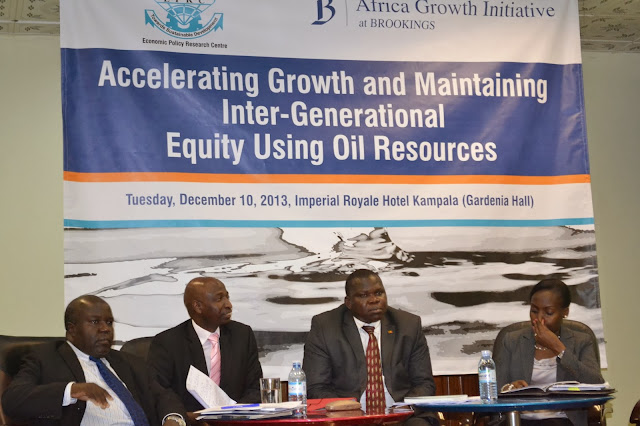
By Esther Nakkazi Ministry of Energy and Mineral Development officials have commended the Economic Policy Research Centre (EPRC) for the research on oil for intergenerational equity. They say EPRC researchers have raised the level of discussion in the oil and gas sector taking adequate stock of what has been done and giving a positive look at what will happen. The research is in a published paper entitled ‘Accelerating Growth and maintaining Intergenerational Equity using oil resources in Uganda,’ presented in Kampala on 10th December 2013 by Lawrence Bategeka, a senior Research Fellow at EPRC and Joseph Mawejje a Research Analyst at EPRC.   The paper suggests things Uganda should do right to avoid the natural resource curse and to ensure that the benefits from oil accrue equally to the current as well as future generations. “It is good to have the academicians and researchers talking about oil. The country can now have an engagement between the people who know and...

Can Uganda achieve intergenerational equity in the use of oil and gas resources?

Image
YES. From a published paper entitled ‘Accelerating Growth and maintaining Intergenerational Equity using Oil resources in Uganda,’ presented by researchers from the Economic Policy Research Centre (EPRC), Makerere University, in Kampala on 10th December 2013. It is possible. A paper by Lawrence Bategeka, a Senior Research Fellow at EPRC and Joseph Mawejje a research analyst at EPRC, suggests things Uganda should do right to avoid the resource curse and ensure that the benefits from oil accrue equally to the current and future generations. The two researchers argue that with a robust legal regime, strong independent institutions, transparency in government operations, communication, prudent public financial management, and responsible environmental management practices, intergenerational equity in respect of use of oil and gas resources is possible. However, the situation in most Africa countries, is that discoveries of significant oil resources has invariably been associate...